I am legend
I Am Legend“I am legend” is the final expression of the novel and the decisive key to its reversal of perspective. Robert Neville reaches it only after understanding that the surviving, organized vampires regard him as he once regarded them: an anomalous and terrifying being whose existence is explained through fear, memory, and stories. His “legend” is therefore not a claim to heroic greatness but the name assigned to him by a new majority that has made his former normality obsolete.
The Expression and Its Immediate Context
The phrase first appears as the title, establishing an interpretive problem before the narrative has explained who might be called legendary. Near the conclusion, it returns as Robert Neville’s final thought, linking the book’s beginning and ending through a compact verbal circle. Between those appearances, the story has followed his solitary struggle against the vampires, his attempts to understand their condition scientifically, and his increasing isolation from any surviving human community.
Its closing force depends on the sentence that precedes it: “Full circle.” Robert Neville has recognized that history has turned against him. The world he knew has disappeared, and the beings he hunted are no longer merely scattered figures of superstition. They have become the people of a new order, while he has become the remnant that order must fear and destroy. The expression names the completion of that reversal rather than a conventional victory.
From Superstition to Historical Reversal
Early in the novel, Robert Neville reflects on the famous assertion, “The strength of the vampire is that no one will believe in him.” The line explains the vampires’ initial advantage: disbelief prevents society from preparing for or resisting a threat it treats as impossible. Robert Neville’s investigations gradually replace folklore with physical explanation. His discovery that bacteria can mutate helps him understand the plague as a biological process rather than a supernatural curse, even though traditional symbols and practices retain practical effects within the altered world.
The final expression reverses the earlier formulation. At first, the vampire is powerful because no one believes in it; at the end, Robert Neville becomes legendary because the new society has made him the object of collective belief. His reputation is built from the bloodless bodies associated with his campaigns, the fear attached to his house, and the testimony of those who have inherited a world shaped by the plague. The transformation is historical as much as personal: what was once an incomprehensible threat becomes the established normality, and the last representative of the old order becomes the monster of the new one.
Majority, Normalcy, and the New People of the Earth
The expression acquires its full meaning when Robert Neville looks down upon the crowd and thinks, “I’m the abnormal one now.” He understands that normalcy is a majority concept, “the standard of many and not the standard of just one man.” This realization changes the moral geometry of the story. Robert Neville does not simply lose a battle; he loses the social authority to define what counts as human, healthy, and monstrous.
The faces below him show awe, fear, and shrinking horror. Robert Neville realizes that they fear him as a scourge worse than the disease they have learned to live with. He understands their response rather than hating them, because their terror is structurally identical to his own earlier terror of the vampires. The phrase “I am legend” thus contains an ethical recognition: a legend is not necessarily true in every detail, but it organizes communal fear and gives a people an account of the danger threatening them.
The Personal Cost Behind the Legend
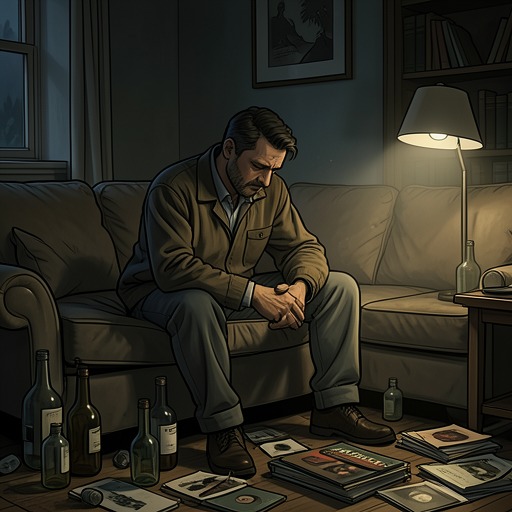
The expression is inseparable from the private losses and compulsions that have shaped Robert Neville’s identity. He has endured years alone in Robert Neville’s house, where routine, alcohol, cigarettes, music, scientific reading, and physical labor barely contain his isolation. He describes himself as a man who is alone, and his body repeatedly becomes the site of conflict: sexual craving, anger, fear, and the effort to impose self-control press against the rational order he tries to maintain.
His violence toward the infected is never presented as emotionally simple. When he stakes a living woman, the act is difficult precisely because she is a woman and because the “senseless demand” returns in his body. He must force the impulse down and convince himself that the act is justified. Ruth later recounts the human suffering behind such encounters: her husband was killed, her two children died in the plague, and she wandered hungry and terrified before Robert Neville pursued and assaulted her. Her account exposes the distance between his self-conception as a defender and the image he has created in the eyes of others.
The same conflict appears in his treatment of Virginia Neville’s body. Although the law requires plague victims to be burned, Robert Neville refuses to surrender her to the fire. He eventually sews a blanket over her face and body, then carries her away, preserving a private bond against the impersonal demands of epidemic law. His refusal gives emotional depth to the final legend: the feared figure is also a widower whose resistance began in love, grief, and the inability to accept that the dead must be treated as contamination.
The Final Reversal
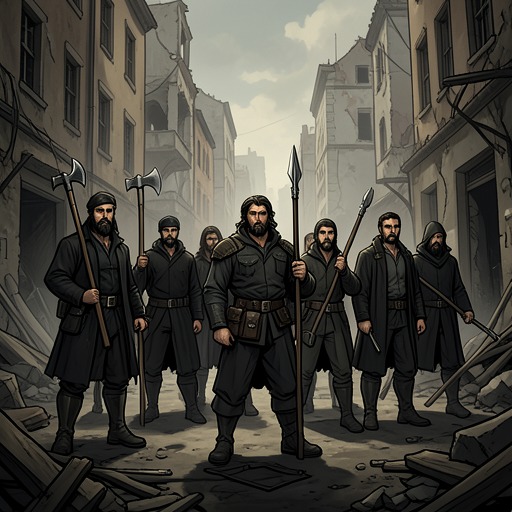
The new society’s attack on Robert Neville’s house makes the reversal physically unavoidable. Its members arrive at night in dark cars, carrying spotlights, guns, axes, and pikes, their lights reaching around the boulevard corner toward Cimarron Street. Robert Neville initially thinks in the old defensive terms, considering his pistols and sub-machine gun and imagining another siege. Instead, he is captured and badly wounded.
When he awakens in a tiny cubicle with barred windows, he remembers the dark men and the attack and understands that his long isolation has ended in imprisonment. His injury, the widening red stain on his bandage, and his recognition that he is going to die reduce the grand historical reversal to bodily pain. Yet the final scene gives him a last act of interpretation. Holding the pills, he sees the people of the new earth as those who have inherited the future, while he himself has become anathema and black terror to be destroyed.
He swallows the pills as a coughing chuckle rises in his throat and thinks, “Full circle,” followed by “I am legend.” The ending joins death, recurrence, and historical memory. A new terror is born in his death, and a new superstition enters what appears to be the permanent structure of the future. Robert Neville’s execution therefore becomes the founding image of another society’s mythology: the solitary human hunter is remembered as the legendary vampire who once haunted the night.